



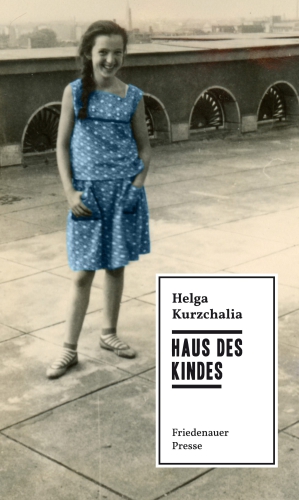
The House of the Child, designed by Hermann Henselmann as a residential and children's department store, was located at the entrance to what was then Stalinallee. Life there serves as the starting point and focal point of an episodic novel that begins before June 17, 1953, and ends in 1965.
When the narrator’s communist parents return to Germany from exile in England after the war, they soon move with their children into the impressive building. Through the girl’s eyes, we meet her neighbors Hermann and Irene Henselmann, Robert and Karin Havemann, and the writers Alex Wedding, F. C. Weiskopf, and Bodo Uhse. They are all united by their belief in a different Germany. But the girl also gets to know others her own age: the boy next door, whose parents were deported to the Soviet Union after the war and whose mother will later flee to the West, her school friend Gilda, who grows up in an old apartment building behind Stalinallee as if in another universe, and the orphaned Zsuzsa, who was brought to Berlin from Hungary after the 1956 Hungarian Uprising. After just a few years, clear rifts begin to appear amongst the residents. The protagonist experiences the contradiction between her privileged situation and the outside world, between Stalinallee and its side streets. Their parents' present is too heavily shaped by their own history of persecution and an idealised vision of the future, full of deception and self-deception. The narrator – as if she were living in a fantasy world – must constantly reassure herself of reality: what is real, what is imagined, and why must things constantly be kept secret?
With House of the Child, Helga Kurzchalia has created a literary quest that combines documentary precision with narrative originality.
Novel
Helga Kurzchalia is a Berlin-based psychotherapist and author. Her published works include Lamaras Briefe oder vom Untergang des Kommunismus (2010), HIER (2007), and Im Halbschlaf (2000). Most recently published by Matthes & Seitz Berlin: Haus des Kindes (2021).